
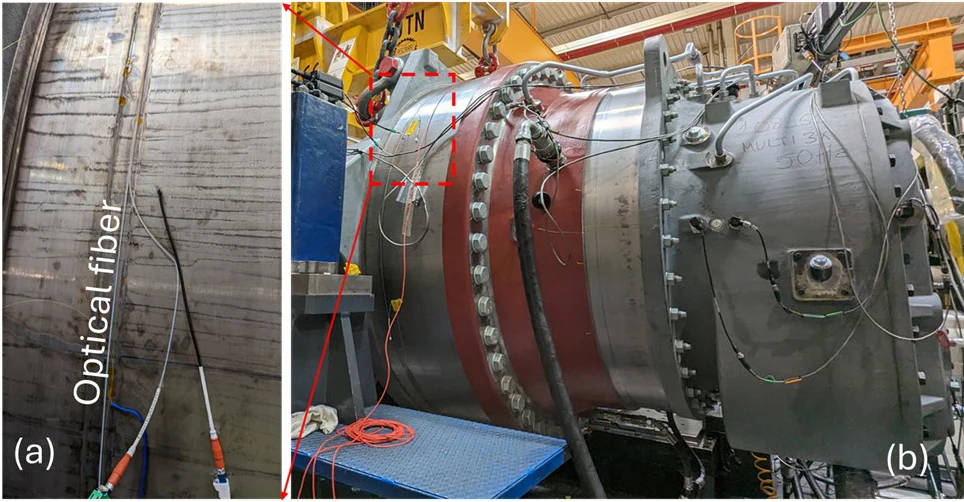
Monitoring task and sensing route
Mechanical response needs separation from slow thermal drift. Speed, torque and rotation direction provide interpretation references, while bonding affects local readings.
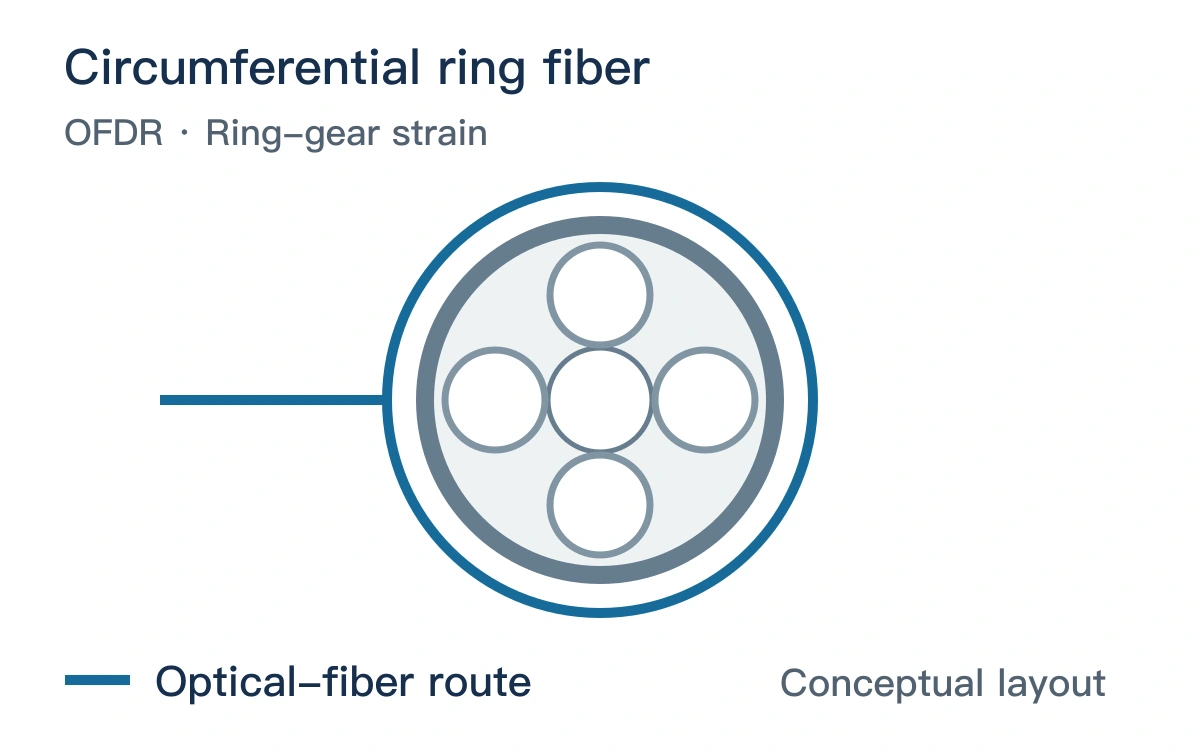
Published research observation
Luo and colleagues used OFDR in a full-scale wind-turbine gearbox bench test, comparing ring-gear strain responses at different input torques. [1]
| Item | Description |
|---|---|
| Study setting | Full-scale gearbox bench testing |
| Research observation | Ring-gear strain related to applied loading |
| Proposed comparison | Document the fiber direction, bonded locations and distance coordinates, with temperature references. |
Validation and integration priorities
Synchronize speed, torque, direction and start-stop events, separating steady and transient operation.
Check repeatability across independent load cycles and review local anomalies with bonding and mechanical inspections.
Reference
[1] Linqing Luo et al. Wind turbine gearbox operation monitoring using high-resolution distributed fiber-optic sensing. Wind Energy Science (2025). DOI: 10.5194/wes-10-1763-2025.