
Distributed acoustic sensing system
2026 High-performance DAS
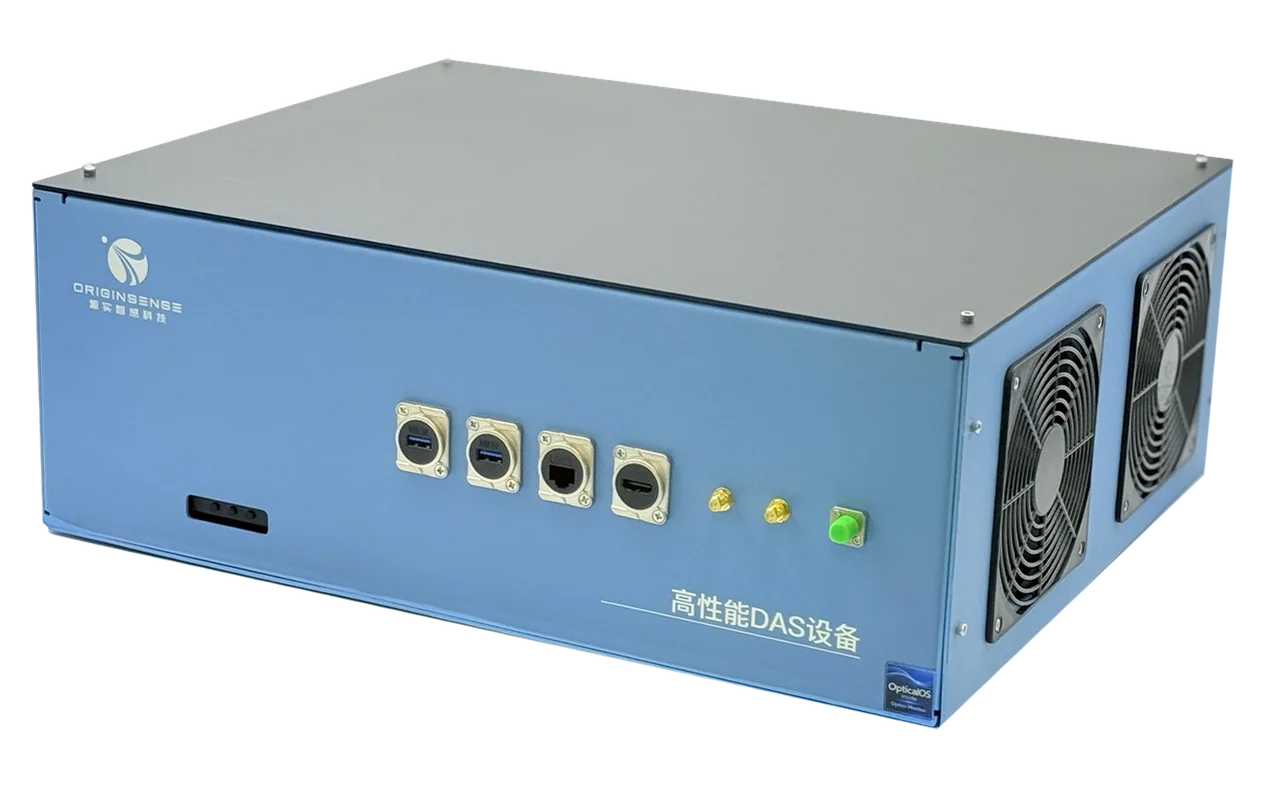
High-quality vibration measurement with integrated real-time analysis, AI recognition and field visualization for research and industrial applications.
ENGINEERED FOR YOUR WORK
From research to field applications.
Preserve the details in every signal
Dual-polarization coherent reception and in-house demodulation provide the signal foundation for waveform reconstruction, spectral analysis and space-time feature extraction.
Acquisition and computing in one system
An NVIDIA Jetson AGX Orin runs acquisition, real-time processing and applications on Linux / ARM64.
A practical path from lab to field
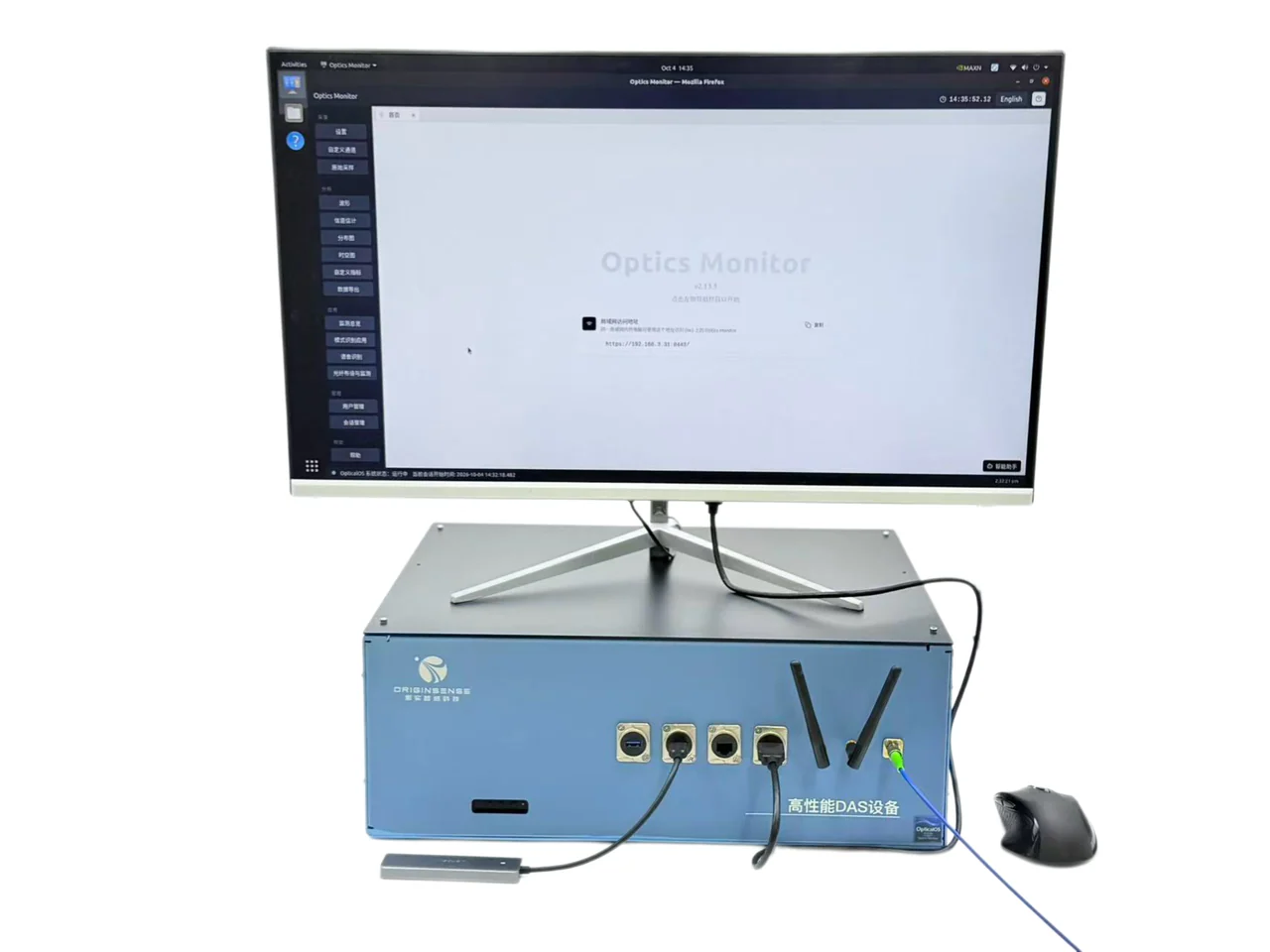
Connect a display and input devices to run Optics Monitor, then acquire, annotate and analyze data on the same platform.
OS-MSP / MEASURED PERFORMANCE
Signal quality, expressed in data.
Results from the 2026 DAS manual, with operating points and measurement conditions stated alongside each metric.
Waveform fidelity
Total harmonic distortion
20-333 Hz fundamental-frequency sweep; maximum across measurement points within a 20 m region near the stated optical path length.
Flat frequency response
Peak-to-peak frequency-response variation
20-800 Hz; maximum across measurement points within a 20 m region near the stated optical path length.
Low noise floor
In-band median noise
20-800 Hz; maximum of the per-point in-band median noise values within a 20 m region near the stated optical path length.
Weak and strong vibrations
Dynamic range
10 Hz signal; conservatively estimated using a 5 dB SNR detection threshold.
Measured on the 2026 DAS system at approximately 1 km and 20 km optical paths, with a 2 kHz temporal sampling rate. The frequency range and statistical basis for each metric are stated above.
OPTICALOS x OPTICS MONITOR
Acquire. Analyze. Recognize. Visualize.
See each vibration in context.
Inspect waveforms, spectra and space-time features. Review recorded events and prepare data for analysis and model training.
OPTICALOS x OPTICS MONITOR2026 STANDARD CONFIGURATION
Configuration and connections
| Optical channels | 1 channel |
|---|---|
| Receiver | Dual-polarization coherent reception |
| Tested optical paths | Approximately 1 km and 20 km |
| Temporal sampling rate | 2 kHz at both stated test operating points |
| Tested frequency range | 20-800 Hz at the 2 kHz test operating point |
| Computing platform | NVIDIA Jetson AGX Orin |
| Main enclosure | 450 x 380 x 165 mm (nominal width x depth x height) |
| System weight | 13.2 kg |
| Optical connector | 1 x FC/APC (wide key) |
| Wired connections | USB 3.0 x 2, LAN x 1, HDMI x 1 |
| System software | OpticalOS, Optics Monitor |
| Integration interface | HTTP REST API |
Approximately 1 km and 20 km are tested optical path lengths. The stated sampling rate and frequency range apply to those test configurations.
LET'S TALK SENSING
Start with your monitoring task.
Tell us about the asset, fiber conditions and research objectives. We will help define the right validation approach.