
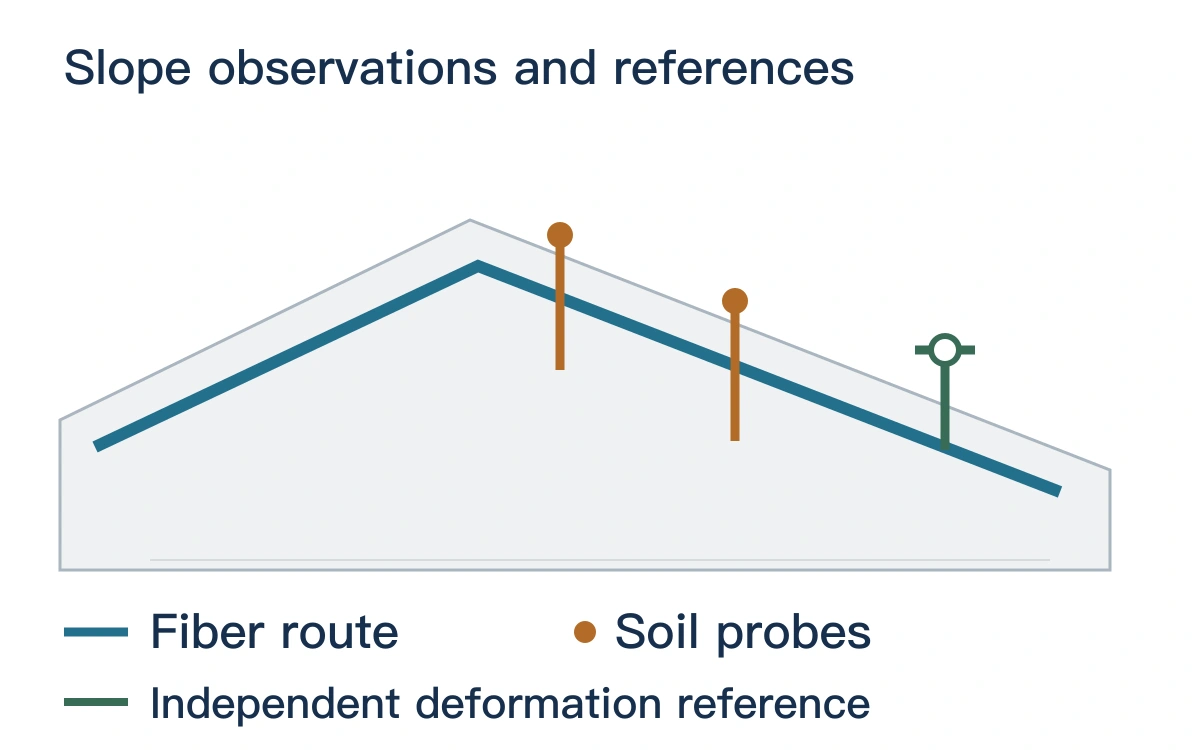
Distributed observations and local references serve different roles
Wetting and drying in soil slopes involve water movement, temperature variation and mechanical response. A fiber route provides observations along a line, while moisture probes, temperature sensors and independent deformation instruments provide local references. A study should first define whether it targets short disturbances, daily variation or trends across rainfall periods, then choose its acquisition and analysis windows.
The response of distributed acoustic sensing (DAS) depends on fiber orientation, cable coupling and interrogator settings. A deployment drawing should identify slope direction, burial depth, joints and spare cable. Recording channel spacing separately from gauge length helps relate fiber distance, spatial averaging and reference locations.
A field study combines two analysis routes
Kang and colleagues conducted two months of soil-slope DAS monitoring in Switzerland, combining seismic-noise velocity changes with low-frequency relative-strain analysis during wetting and drying. Their final paper includes treatment of instrumental drift and temperature effects. [1]
For a comparable study, each analysis route needs its own time window, reference state and comparison target. Velocity-change interpretation depends on the wavefield and processing method. Integrating low-frequency records into relative changes requires retaining the raw data, initial reference, and drift and thermal processing steps.
| Basis or object | Interpretation and validation task |
|---|---|
| Field observation in [1] | Two months of slope observations, interpreted within the study's site and processing conditions. |
| Proposed: relative response | Align the reference time, document thermal and drift treatment, and compare with independent deformation measurements. |
| Proposed: spatial correspondence | Include route orientation, coupling, channel spacing and gauge length in the interpretation. |
A reproducible trial needs aligned reference records
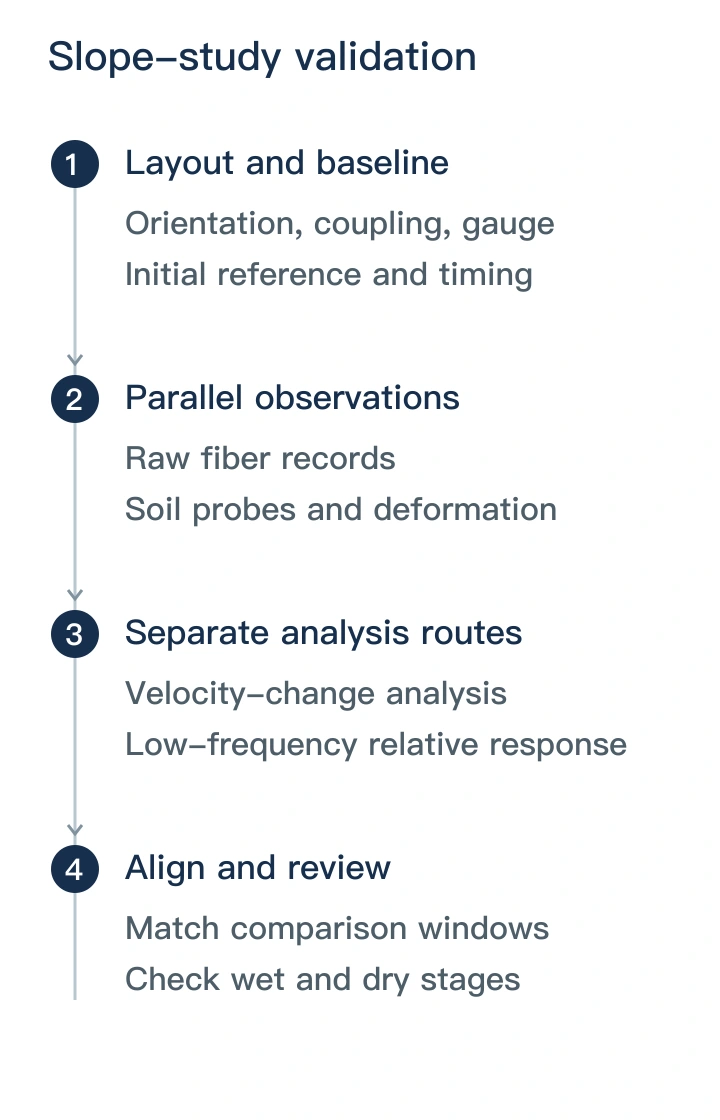
Start with a trial area that supports independent observations. Retain route and sensor coordinates, a common time base, raw fiber records and environmental measurements. Rainfall and construction activity should have explicit time intervals; gaps, maintenance and cable reattachment belong in the same trial log.
Before acceptance, agree on comparison periods, reference instruments, spatial matching and error statistics. Review different wetting and drying stages separately and retain time periods that were not used for tuning. This structure helps researchers reproduce the analysis and gives integrators a basis for specifying data interfaces and operational checks.
From a monitoring objective to a trial specification
A technical discussion can begin with the trial site, available fiber, independent reference locations and required data deliverables. These inputs guide equipment settings, recording duration, analysis methods and the validation plan, keeping acquisition and interpretation aligned with the application objective.
Reference
[1] Kang, J., Walter, F., Halter, T., Paitz, P., and Fichtner, A. Soil slope monitoring with Distributed Acoustic Sensing under wetting and drying cycles. Earth Surface Dynamics, 13, 1133–1155 (2025). DOI: 10.5194/esurf-13-1133-2025.