
A persistent strain change after a wire break
A broken prestressing wire redistributes strain in the surrounding concrete. Monitoring this persistent change requires attention to both longitudinal position and the location of the sensor across the section. A study by Richter, Will, Herbers and Marx, published in 2025, examined that response with distributed fibre-optic strain sensing. [1]
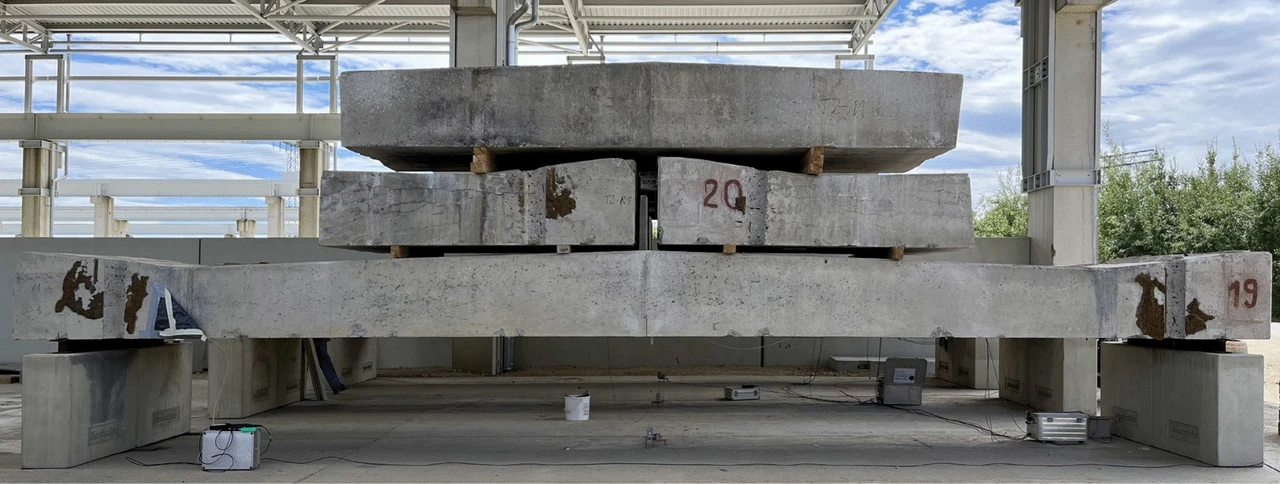
The experiment took place in 2022 on a retired railway-bridge girder, 11.96 m long on an 11 m support span. Stacked girders supplied approximately 400 kN of dead load while researchers mechanically cut wires in stages. Before loading, a prepared midspan saw cut had already intersected the lower six of ten tendons; the subsequent measurements concerned cuts in two other, upper outer tendons. This preparation forms part of the controlled test conditions. [1]
Three surface paths reveal the effect of position
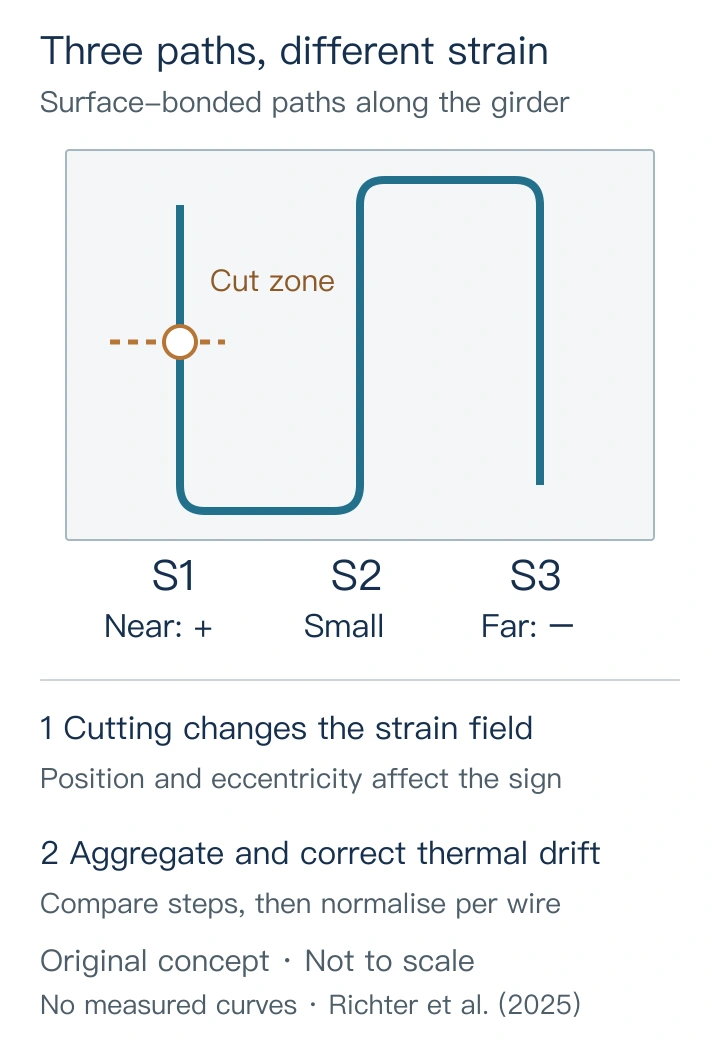
The sensing route was coherent optical frequency-domain reflectometry, or c-OFDR, for distributed quasi-static strain. Approximately 30 m of fibre formed an S-shaped layout with three longitudinal sensing sections of about 8 m each. These occupied different lateral positions on the girder underside, bonded into approximately 5 × 5 mm grooves and protected with mortar. [1]
Following cutting, the near-side section S1 primarily elongated. The opposite section S3 showed compression associated with eccentric bending, while the central section S2 responded weakly. The differences show why a strain amplitude on one path cannot describe the response of the entire cross-section. [1]
Read per-wire responses alongside the processing conditions
The authors compared successive cutting steps and divided each strain change by the number of wires cut in that step. The resulting per-wire values do not all represent separate, individually observed single-wire events. The responses below include preprocessing and thermal correction. The noise standard deviation describes an earlier processing stage and cannot be divided directly into those responses to obtain a signal-to-noise ratio. [1]
| Item | Value or condition |
|---|---|
| S1 near | Approximately +2 to +3 µm/m per cut wire after processing: elongation. |
| S2 mid | Approximately +0.1 µm/m per cut wire. |
| S3 far | Approximately −0.8 µm/m per cut wire, influenced by eccentric bending. |
| Noise | Strain standard deviation of approximately 2–10 µm/m across sensing points, at a different processing stage from the responses above. |
| Thermal | No simultaneous temperature sensors; reference intervals with limited mechanical influence supported thermal-trend correction. |
Thermal drift and independent references shape validation
The c-OFDR signal responds to temperature as well as strain. The study removed anomalous points, aggregated measurements using a median over each measurement period, applied spatial filtering and fitted a thermal trend using reference intervals. Those intervals needed limited mechanical influence from the cuts. Uneven exposure to sunlight also affected the thermal conditions. [1]
A follow-on trial can place sensing paths near, centrally and opposite the affected tendon, record independent cutting or loading times, and add direct temperature measurements. Retaining raw data and missing-data masks allows the effect of processing choices on small strain steps to be assessed before rules are tested on independent conditions. These are trial-design implications drawn from the study conditions.
The paper discusses uncracked concrete with subsequently bonded post-tensioning. Cracking, creep, traffic loading and long-term thermal exposure change the transfer relationship and belong in validation for a specific structure. The route examined here measures distributed quasi-static strain; its observable and processing window need to match the monitoring task. [1]
Reference
[1] Bertram Richter, Elias Will, Max Herbers and Steffen Marx Detection of prestressing wire breaks in post-tensioned concrete structures using distributed fiber optic strain sensing. Journal of Civil Structural Health Monitoring 15, 3819–3840 (2025). DOI: 10.1007/s13349-025-01018-5.