

Monitoring task and sensing route
Interpretation should include textile orientation, bonded length and load position. Repeat trials need comparable excitation locations and procedures.
Published research observation
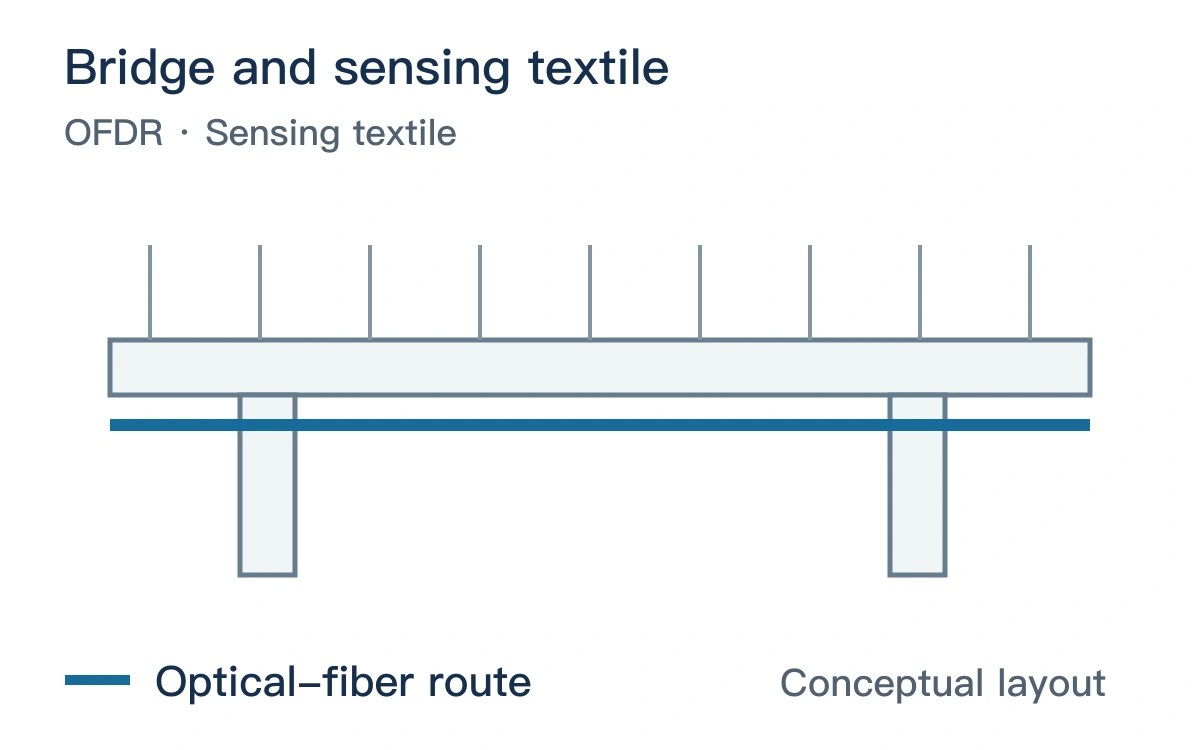
Abedin and colleagues installed fiber-embedded textile on a pedestrian bridge and used OFDR to compare dynamic response patterns and amplitudes across annual loading tests. [1]
| Item | Description |
|---|---|
| Study setting | Pedestrian-bridge installation and annual tests |
| Research observation | Response patterns and amplitudes compared over time |
| Proposed comparison | Retain installation records for textile, fiber and structural attachment, marking load positions. |
Validation and integration priorities
Repeat comparable excitation with temperature and site-condition logs.
Assess frequency patterns, amplitude and bonding separately, using independent structural measurements to interpret changes.
Reference
[1] Abedin S et al. Structural Health Monitoring Using a New Type of Distributed Fiber Optic Smart Textiles in Combination with Optical Frequency Domain Reflectometry (OFDR): Taking a Pedestrian Bridge as Case Study. Sensors (Basel, Switzerland) (2023). DOI: 10.3390/s23031591.