
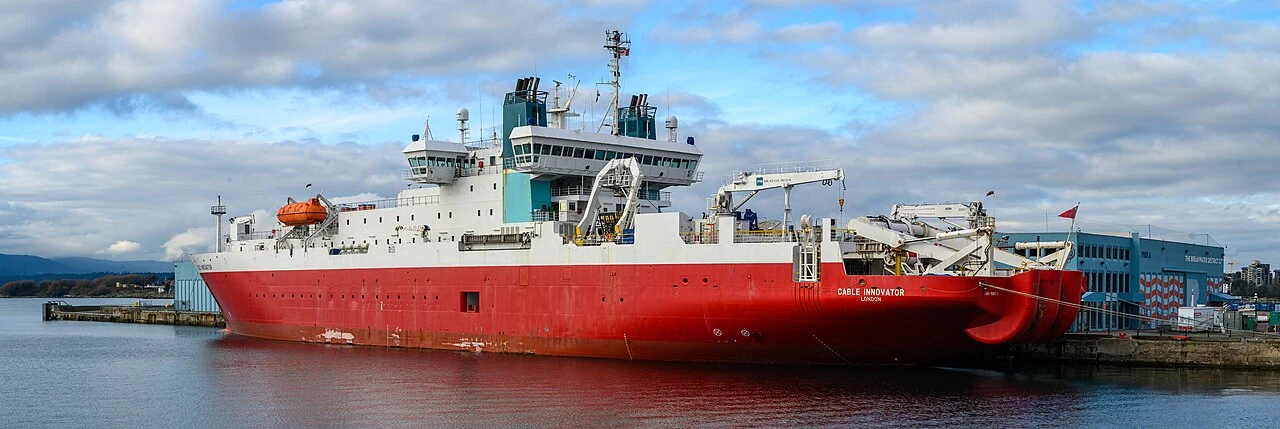
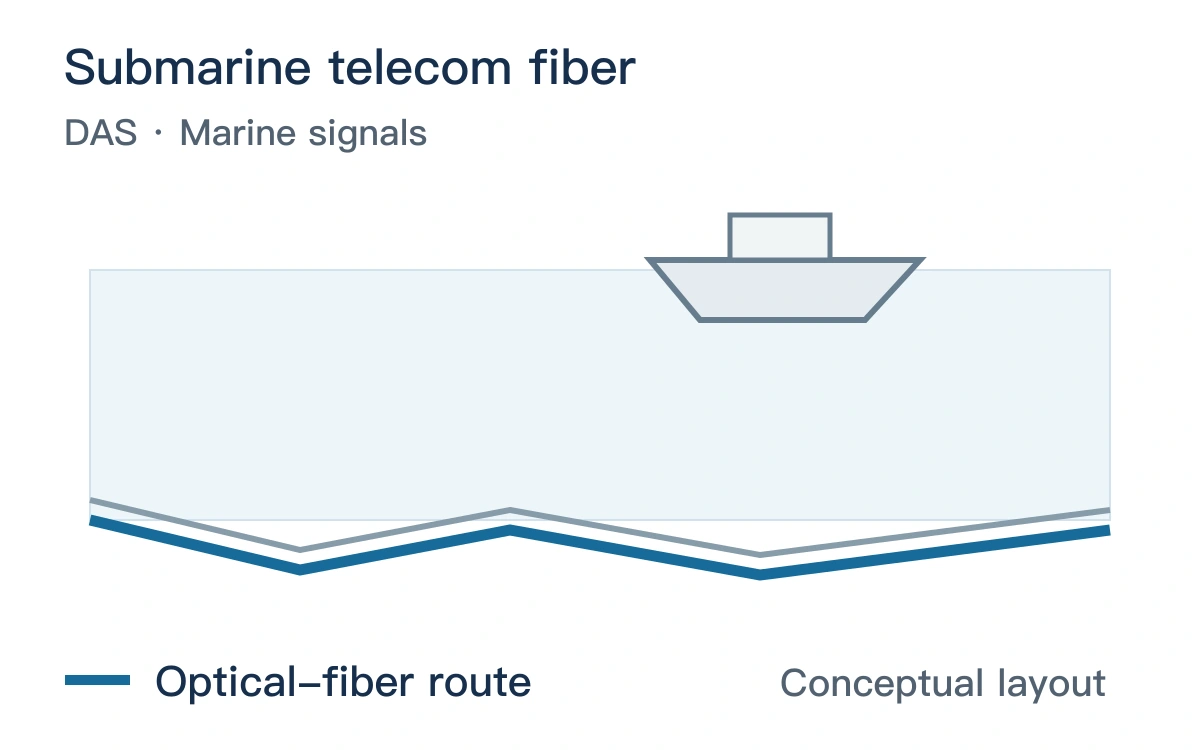
Monitoring task and sensing route
Window extraction affects spectra and clustering. Vessel interpretation needs independent records such as AIS; persistent low-frequency responses also require environmental context.
Published research observation
Pedersen and colleagues analyzed submarine-cable DAS data with automated detection and clustering, using vessel and earthquake information to support labeling. [1]
| Item | Description |
|---|---|
| Study setting | Analysis of submarine telecommunications-cable records |
| Research observation | Candidate-signal screening with auxiliary labels |
| Proposed comparison | Map buried, exposed and shore sections, retaining sea-state and tidal records. |
Validation and integration priorities
Check labels against independent vessel tracks and event catalogs; keep unresolved sources unclassified.
Review overlapping events in extracted windows and test by independent voyage and date.
Reference
[1] Pedersen HB et al. A Feasibility Study of Automated Detection and Classification of Signals in Distributed Acoustic Sensing. Sensors (Basel, Switzerland) (2025). DOI: 10.3390/s25175445.