
Bed-level observations connect scour and foundation monitoring
Sediment transport around a bridge pier changes the surrounding bed elevation. Locating the sediment-water interface along a vertical probe, together with the water surface, helps relate bed-level observations to water-level changes. A monitoring plan needs a reference datum, probe coordinates and an independent checking method.
In a 2023 proof-of-concept study, Hatley and colleagues used an actively heated distributed fiber-optic temperature-sensing device to identify sediment-water and water-air interfaces in a laboratory flume. [1] The study provides a specific thermal route for observing these boundaries.
Raman DTS reads the temperature response to heating
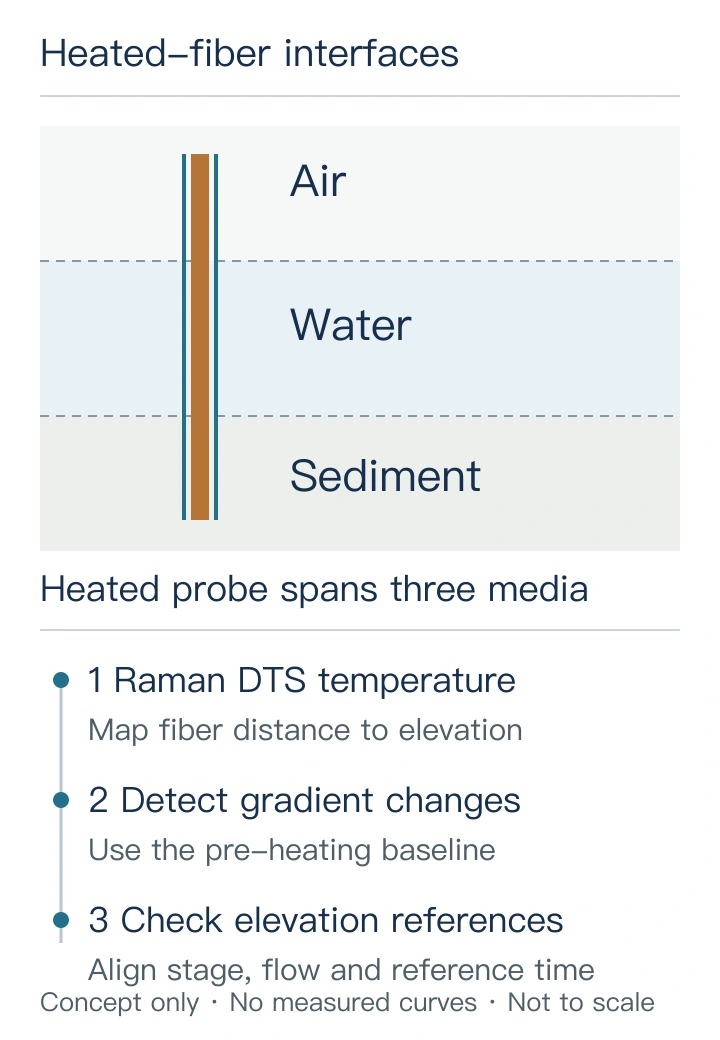
The method applies a heat pulse through metallic components of the cable and reads temperature along the fiber with Raman distributed temperature sensing (DTS). Air, water and sediment transfer heat differently. The resulting changes in the vertical temperature-increase gradient identify the interfaces.
The researchers wound the cable around a tubular support to map a long fiber path onto a short vertical observation interval. Interpretation therefore requires the fiber coordinate, winding geometry and elevation conversion. Along-fiber sampling interval and vertical interface error describe different aspects of the measurement.
Flume results describe interface detection under stated conditions
The study tested standing water and two flowing-water conditions, with three replicates per condition and velocities from approximately 0 to 0.16 m/s. In the results table, the nine sediment-water interface errors have a mean absolute value of 1.60 cm; signed water-air interface errors range from −2.41 cm to +0.54 cm. [1]
The tests produced no significant scour. Minor sediment movement occurred in the higher-flow group. Reference interface positions were measured with a tape before each heating test, so movement during a test and the timing of the reference measurement both matter when interpreting error. The directly tested outcome is interface identification in the stated flume conditions.
| Item | Result and scope |
|---|---|
| Setup | Laboratory flume and fine sand; standing water to approximately 0.16 m/s; three replicates for each of three conditions. |
| Bed / water | Mean absolute error of 1.60 cm across nine tests; reference positions measured before heating. |
| Water / air | Signed errors range from −2.41 to +0.54 cm across nine tests, evaluated separately from the bed interface. |
| Bed change | No significant scour in these tests; minor sediment movement in the higher-flow condition. |
| Next steps | The authors identify different sediments, field conditions, heating power and pulse duration as further research topics. |
Bridge trials need aligned elevation and hydraulic references
Researchers and integrators can define a trial around probe position relative to the pier, the required elevation range, reference measurements and data deliverables. Heating input, ambient water temperature, stage and velocity need a common time base to distinguish changes in surrounding material from changes in hydraulic conditions.
An independent bed survey and time-aligned records of scour, deposition and maintenance support evaluation. Comparison periods should distinguish sediment type, installation and hydraulic conditions before assessing interface error, observation interval and continuous operation. These records provide a basis for equipment selection and acceptance criteria.
Reference
[1] Hatley, R.; Shehata, M.; Sayde, C.; Castro-Bolinaga, C. High-Resolution Monitoring of Scour Using a Novel Fiber-Optic Distributed Temperature Sensing Device: A Proof-of-Concept Laboratory Study. Sensors, 23(7), 3758 (2023). DOI: 10.3390/s23073758.